
Paris Becomes the Center of Competitive Gaming: Inside the 2026 Esports World Cup
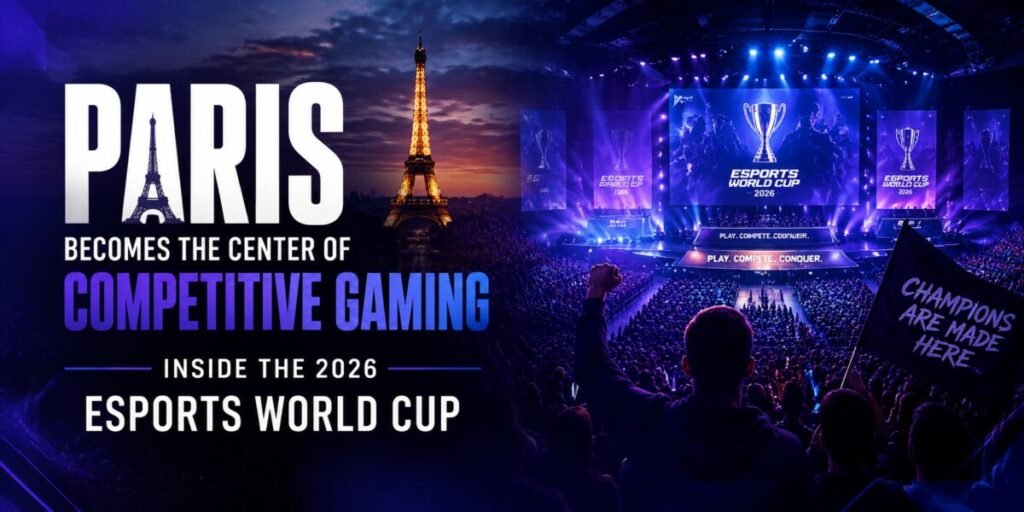
There is no bigger single event on the competitive gaming calendar this year than the Esports World Cup. Now in its third edition, the tournament series has planted itself in Paris for the summer of 2026, running from July 6 through August 23 across the Paris Expo Porte de Versailles. Organized by the Esports Foundation and supervised by ESL, the 2026 edition spans 25 individual events across 24 different esports, all feeding into a combined prize purse reported at roughly $75 million — a scale that would have seemed almost unbelievable in competitive gaming even five years ago.
With the event running for weeks rather than days, its narrative has unfolded in waves. Here’s a look at how it’s gone so far, and why this summer’s edition matters for the wider esports landscape.
A Venue With Pedigree
The choice of Paris wasn’t arbitrary. The Paris Expo Porte de Versailles has hosted major esports moments before, including the 2019 League of Legends World Championship final and the 2023 BLAST.tv Paris Major for Counter-Strike: Global Offensive, as well as the 2025 Valorant Champions. Choosing the venue again for 2026 signals an intent to build continuity — a recognizable home for high-stakes competitive gaming rather than a rotating carousel of one-off host cities.
That continuity matters for an event structured the way the Esports World Cup is. Rather than a single game crowning a single champion, the event functions as a season-long, cross-title festival, complete with its own Club Championship — a points system that rewards organizations for fielding competitive rosters across multiple games rather than specializing narrowly in one.
Street Fighter 6: A Teenager Makes History
Among the standout storylines from this year’s event is the rise of Jaime “Craime” Bustos, a 15-year-old Chilean prospect who claimed the Street Fighter 6 championship at Esports World Cup 2026, defeating a field of 32 of the world’s best fighting game competitors for a share of the tournament’s $1,000,000 prize pool. The win, secured on the main stage at the Paris Expo, instantly established Craime as one of the youngest champions in the event’s history, and as one of the fighting game community’s most closely watched rising stars heading into the rest of the competitive year.
It’s the kind of moment that tournament organizers dream of — a young, telegenic talent breaking through on one of the sport’s biggest stages, giving the fighting game scene a fresh face to build hype around for years to come.
Team Spirit’s Thriller in Mobile Legends
Not every headline moment came from a traditional PC or console title. In Mobile Legends: Bang Bang, Team Spirit outlasted Yangon Galacticos in a dramatic 4–3 Grand Final at the Mid Season Cup, claiming $1,000,000 in prize money and 1,000 Club Championship points along the way. The victory carried extra significance as the EECA region’s first major international title in the game, underscoring how thoroughly the Esports World Cup’s broad multi-title format has opened doors for regions and titles that don’t always get top billing on the biggest Western stages.
Mobile esports in general continues to be an underrated force in these numbers. PUBG Mobile’s own World Cup, running concurrently with a $3,000,000 prize pool, is one of several mobile-first competitions treated with the same seriousness — and the same money — as their PC and console counterparts.
PUBG: BATTLEGROUNDS Crowns a New Champion
On the battle royale side, Virtus.pro claimed the PUBG: BATTLEGROUNDS championship after a tense three-day finals battle against sixteen other qualified teams. Virtus.pro built an early lead in the finals and never relinquished it, closing out the tournament with the kind of consistent, mistake-free play that separates champions from the rest of the field over a multi-day format. It’s a notable result for an organization with deep roots in more traditional esports like Counter-Strike and Dota 2, further reinforcing that success at the Esports World Cup increasingly depends on an organization’s ability to field competitive talent across a genuinely wide range of games.
Beyond the Main Stage: Fan Fest and the Culture Around Competition
The Esports World Cup has never been just about who wins. Running alongside the competitive schedule is Fan Fest, a dedicated space bringing together content creators, developers, esports organizations, and fans in one shared venue. Reports from the event describe it as a genuine hub of activity each week, giving the tournament a festival atmosphere that stretches well beyond the competitive stage itself — closer in spirit to a gaming convention than a traditional sports tournament.
That combination — serious competition paired with a broader celebratory atmosphere — has become something of a signature for the event, and it’s part of why the Esports World Cup has managed to draw attention even during weeks when no single marquee title is in the spotlight.
The Rest of the Competitive Calendar Doesn’t Slow Down
Even with Paris commanding attention, the broader 2026 esports calendar has stayed remarkably busy. Counter-Strike 2’s competitive season continued with the IEM Cologne Major, a $1,250,000 event featuring 32 teams across a three-stage Swiss format culminating in a single-elimination playoff, with Team Vitality entering as back-to-back defending champions. A second, final CS2 Major of the year is scheduled for Singapore later in 2026, organized by PGL, continuing what has become a genuinely global rotation of top-tier Counter-Strike events.
Meanwhile, League of Legends is gearing up for its own centerpiece: the 2026 World Championship, set to be hosted in North America after the United States was confirmed as the host country following the conclusion of the 2025 event in Chengdu. T1 enters as three-time defending champions, giving the League scene one of its most compelling dynasties in years to defend or dethrone.
Prize Pools by the Numbers
Understanding the financial scale of these events helps explain why organizations are increasingly investing in rosters across so many different titles. PUBG Mobile’s World Cup alone carries a $3,000,000 purse, matched by its later-year sibling event, the PUBG Mobile Global Championship, which runs from November into December with an identical prize figure. Mobile Legends: Bang Bang’s Mid Season Cup carried the same $3,000,000 threshold, putting it on par with far more traditionally recognized PC esports in terms of raw financial stakes, even if mainstream Western media coverage hasn’t always caught up to that reality.
Fighting games and shooters occupy a different tier of the prize pool hierarchy but are far from an afterthought: Street Fighter 6’s $1,000,000 pool at the Esports World Cup put Craime’s championship win squarely among the most lucrative individual results of his young career, while the Call of Duty: Warzone Resurgence Series Championship added yet another significant purse to the summer’s packed schedule. Later in the year, the SNK World Championship Finals for Fatal Fury is set to carry a $2,500,000 prize pool of its own, another reminder of just how broad — and how well-funded — the modern esports calendar has become outside of the handful of titles that dominate mainstream headlines.
How to Actually Watch
For newcomers trying to follow along, the sheer number of concurrent events across the Esports World Cup’s nearly two-month run can feel overwhelming. The most practical approach is to pick one or two games you already have some familiarity with and follow those specific brackets rather than attempting to track all 25 events simultaneously. Official streams for each title are typically hosted on the relevant game’s own primary esports channels, with the Esports World Cup’s own channels aggregating schedule information and cross-promoting standout matches across titles as the event progresses toward its August 23 close.
For anyone physically in Paris, the Fan Fest programming running alongside the competitive schedule offers a lower-commitment way to experience the event’s atmosphere without needing deep familiarity with any single game’s competitive scene — a deliberate design choice that has helped the event build an audience well beyond hardcore esports followers.
The Club Championship: Building Multi-Game Dynasties
Perhaps the most structurally interesting element of the Esports World Cup is the Club Championship, a cross-game points system that rewards organizations for fielding competitive teams across as many different titles as possible rather than specializing narrowly. It’s a format that actively encourages the kind of roster diversification seen from organizations like Team Spirit and Virtus.pro this year, both of which picked up major results in titles somewhat removed from the games that originally built their reputations. Over time, this incentive structure is gradually reshaping what it means to be a top-tier esports organization — success increasingly depends on breadth of talent management across a portfolio of games rather than deep specialization in a single one.
For fans, this format also creates a season-long narrative that a single-title tournament simply can’t replicate. An organization’s overall standing in the Club Championship becomes its own storyline, running in parallel to whichever individual game’s bracket happens to be capturing headlines in a given week — giving the Esports World Cup a structure that rewards sustained engagement across its full nearly two-month run rather than attention only during a marquee title’s finals weekend.
What This Means for Competitive Gaming’s Bigger Picture
Taken together, the scale of the 2026 Esports World Cup — 25 events, 24 games, $75 million on the line, running across nearly two months in one of Europe’s most recognizable event venues — says something significant about where competitive gaming has landed as an industry. This is no longer a niche pursuit chasing legitimacy; it’s a genuine international spectacle with the infrastructure, sponsorship, and viewership to match traditional professional sports in scale, if not yet always in mainstream visibility.
With weeks of competition still remaining in Paris and the League of Legends World Championship still ahead later this year, 2026 is shaping up as one of the most significant years yet for competitive gaming — not because of any single result, but because of just how much is happening, across how many different games, all at once.