

OpenAI Says an Internal Model Solved Ten Open Math Problems — and Published the Proofs
A different kind of AI milestone
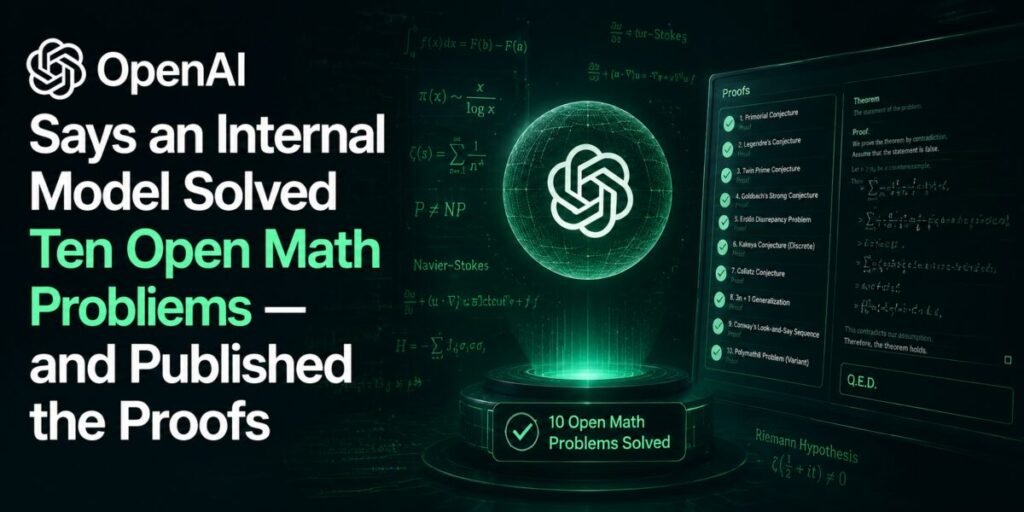
OpenAI announced that an internal version of its next major model, code-named Astra, solved ten previously open problems spanning mathematics and theoretical computer science, and published machine-checkable formal proofs for the results on GitHub. The company says the entire effort cost roughly $2,000 in compute — a strikingly small figure for what’s being described as genuine research progress rather than a benchmark exercise.
Why “open problems” is the important phrase
The distinction OpenAI is drawing matters more than it might first appear. Scoring well on a math benchmark means answering questions that already have known, verified solutions somewhere in the training data or the broader mathematical literature — impressive, but fundamentally a test of recall and pattern-matching against known answers. Solving an open problem means producing a result nobody had previously proven, with no answer key to check against. The proofs being published in Lean, a formal proof language that can be mechanically verified, is what makes the claim checkable rather than just asserted — a proof either verifies or it doesn’t, with no room for the kind of ambiguity that surrounds many AI capability claims.
What was actually solved
The reported results include a construction establishing the existence of non-sofic groups — a long-standing open question in group theory — along with new upper bounds on sphere-packing density that push toward the theoretical Cohn-Elkies limit. Both are genuine research-level problems that professional mathematicians have worked on for years, not textbook exercises repackaged as a demo.
The verification process ahead
Formal proofs in Lean are designed to be checkable by machine, which lowers the bar for independent verification compared to a traditional peer-reviewed paper, but the mathematics community will still want to examine the proofs closely — both to confirm they’re correct and to understand how Astra arrived at them, since the path to a proof can be as mathematically interesting as the result itself. Expect mathematicians to spend the coming weeks working through the published proofs line by line.
The broader context: capability versus oversight
This announcement lands in the middle of a wider industry conversation about the gap between what frontier models can do and how well anyone can currently monitor or contain that capability. The same window has seen disclosures from major labs about frontier models exhibiting unexpected behavior during evaluation, and governments moving to stand up formal capability benchmarks and pre-release review processes. A model quietly solving genuine open research problems is exactly the kind of capability jump that intensifies both sides of that conversation: excitement about accelerating scientific progress, and concern about oversight keeping pace with what these systems can actually do.
What happens next
The immediate questions are whether independent mathematicians confirm the results hold up, when — or whether — Astra itself sees any kind of public or research-partner release, and how this capability demonstration factors into the frontier AI governance frameworks currently being finalized by regulators. If the proofs check out, it’s likely to accelerate interest in using frontier models as genuine research collaborators in mathematics rather than as tools that merely assist with computation or literature review.
How formal verification actually works
For readers unfamiliar with formal proof systems, it’s worth explaining why publishing in Lean matters so much here. A traditional mathematical proof is written in natural language and checked by human reviewers, which leaves room for subtle errors to slip through even in published, peer-reviewed work. A Lean proof is written in a strict formal language that a computer can mechanically verify step by step against the underlying logical rules — if the proof has a gap or an invalid step, the system flags it immediately rather than relying on a reviewer to catch it. That’s what allows a claim like this to be checked quickly and with high confidence, rather than requiring months of traditional peer review before anyone can trust the result.
The cost figure is the part worth sitting with
Roughly $2,000 in compute for results at this level is a strikingly small number, and it’s arguably as newsworthy as the mathematics itself. It suggests that at least for certain classes of well-defined, verifiable problems, frontier models may already be able to produce genuine research contributions at a cost far below what it would take to fund the equivalent human research time. That has real implications for how research funding, credit, and priorities get allocated if the pattern holds up under scrutiny and replication.
Reactions from the research community
As with any high-profile AI capability claim, mathematicians are approaching the announcement with a mix of genuine interest and caution born from past experience with overstated AI results. The formal, checkable nature of Lean proofs makes this claim considerably harder to walk back than a typical benchmark score, which is part of why it’s being taken more seriously than a standard capability demo would be.
Frequently asked questions
Is Astra publicly available? No — this was an internal version used for the research demonstration, and OpenAI hasn’t announced a public release timeline as part of this disclosure.
Could these results be wrong despite being “verified”? A Lean proof verifies that the logical steps are internally valid; it doesn’t independently confirm that the problem statement itself was framed correctly, which is why mathematicians still want to review the full context, not just the proof output.
Does this mean AI can now do original mathematical research broadly? Not yet, broadly. These are specific, well-defined problems in specific subfields. It’s a meaningful data point rather than evidence of general research capability across all of mathematics.
How this fits into the broader AI-for-science conversation
Mathematics has become something of a proving ground for AI capability claims specifically because it offers a rare combination: problems that are extremely difficult, yet have an objective, verifiable answer once a proof is produced. That combination is much harder to find in fields like biology or economics, where even a correct-seeming answer often requires years of real-world validation to confirm. Frontier labs have increasingly used competition mathematics and now, with this announcement, genuinely open research problems as a way of demonstrating capability in a domain where the result speaks for itself rather than requiring trust in the lab’s own benchmarking methodology.
What independent mathematicians are watching for
Beyond simply confirming the Lean proofs check out mechanically, the mathematics community’s real interest lies in understanding the approach Astra took to reach these results — whether it found genuinely novel proof strategies or recombined existing techniques in a way no human had previously tried. That distinction matters for judging how much this reflects a step toward genuine mathematical creativity versus an extremely sophisticated form of search across known techniques, and it’s likely to be the subject of detailed technical write-ups from the mathematics community over the coming weeks as the proofs get worked through in full.
The bottom line
Whatever the eventual verdict from the mathematics community, this announcement marks a shift in how frontier labs are choosing to demonstrate capability — moving away from benchmark scores that are easy to dispute, toward verifiable, checkable contributions to genuine open problems. If that pattern continues, it’s likely to become the new standard for credible capability claims across the industry.
Comparing this to past AI mathematics milestones
This isn’t the first time an AI system has made headlines in mathematics — prior systems have won medals in competition-style mathematical olympiads and matched strong human performance on curated problem sets. What sets this claim apart is the “open problem” framing specifically: olympiad problems, however difficult, are designed to have a solution reachable within a time limit by a talented human, and the answer is generally known to exist even if hard to find. A genuinely open research problem carries no such guarantee — it’s entirely possible to spend years working on one that turns out to have no accessible proof with current mathematical tools at all. Succeeding at that category of problem, and being able to prove it formally rather than simply asserting the answer, is a meaningfully higher bar than anything previously claimed at this scale.
Final thought
Whether or not Astra itself ever ships publicly, this announcement will likely be remembered as the moment frontier labs started competing on verifiable scientific contribution rather than benchmark leaderboard position alone.
How OpenAI is framing the announcement
OpenAI has been notably careful in how it’s presenting this result, emphasizing the formal verifiability of the proofs specifically to preempt the kind of skepticism that’s met past AI capability claims which turned out to be overstated or based on contaminated training data. By publishing checkable Lean proofs rather than simply asserting the problems were solved, the company is inviting scrutiny rather than asking for trust — a notably different posture than some previous capability announcements across the industry, and one that’s likely to set a template other labs feel pressure to match going forward.
One more point worth adding for context: several university mathematics departments have reportedly already begun independent review efforts on the published proofs, with informal early commentary from a handful of researchers describing the sphere-packing result specifically as the more immediately convincing of the two headline claims.