

Fixer Undercover Review: The Smartest VR Puzzle Game Nobody’s Talking About Yet
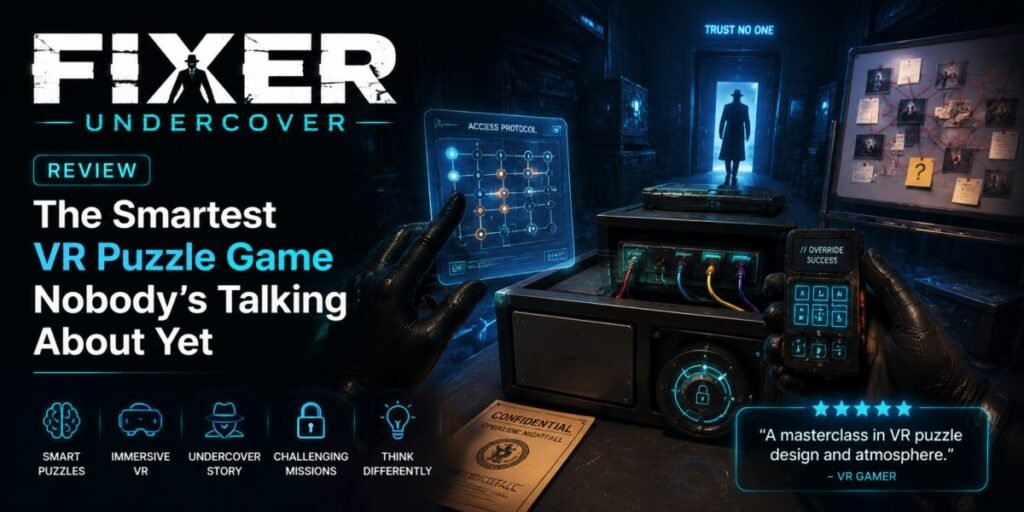
Most VR puzzle games ask you to wave your hands at objects until something clicks. Fixer Undercover asks you to actually think — and it’s one of the smartest things we’ve played on Quest all year.
You play as Agent 404, deep undercover inside a prison whose warden runs a supposed rehabilitation “miracle program” that is, predictably, hiding something much stranger underneath. The premise sounds like standard VR thriller boilerplate, and for the first twenty minutes, it plays that way too — until the game reveals its actual mechanical identity: a grounded, tool-based repair-and-investigation puzzler where every solution comes from observation and physical logic rather than arbitrary VR hand-waving. That shift in the opening act is a genuinely well-executed bait-and-switch, and it sets the tone for everything that follows.
The Core Conceit: Repair as Investigation
Posing as a maintenance worker gives Agent 404 a plausible in-fiction reason to be crawling through vents, disassembling machinery, and rerouting power throughout the facility — and the game leans hard into that framing rather than treating it as a thin excuse for generic puzzle mechanics. You’ll grind rust off corroded panels to reveal hidden serial numbers, measure gaps and components with an actual in-hand tool rather than an eyeballed guess, and reroute power through junction boxes where the “puzzle” is genuinely electrical logic rather than an arbitrary lock-and-key abstraction. Every solution feels earned because it emerges from the internal logic of the space you’re in, not from a designer dropping an obviously-placed hint object in your path.
Winston: The Drone Companion Done Right
Your companion throughout is a small utility drone named Winston, who handles jobs your hands physically can’t — squeezing into narrow gaps, scouting ahead into areas you can’t yet access, or providing a second camera angle on a mechanism you’re working on blind. Companion characters in VR puzzle games frequently feel like a gimmick bolted on for marketing purposes; Winston avoids that trap almost entirely by being mechanically necessary rather than merely charming. There were several puzzles we simply couldn’t have solved without actively directing him, which is exactly the bar a companion mechanic should have to clear to justify its existence.
Puzzle Design: Observation Over Trial-and-Error
This is the section of the review that matters most, because it’s where Fixer Undercover separates itself from a genre that’s historically been content with “wave hands until something works” design. The best puzzles here reward players who actually stop and read the environment — noticing a discoloration pattern on a wall, cross-referencing a serial number scrawled on a work order with a component buried in a locked cabinet, or realizing that a tool you picked up three rooms ago has a secondary function you hadn’t needed yet. Nothing here relies on pixel-hunting or arbitrary combinations; every solution, once found, feels obvious in retrospect in exactly the way good puzzle design should.
The best solutions come from observation, tool use, and environmental context — not from waving objects around until something works. That single design principle, applied consistently, is what elevates this above most of its genre peers.
Atmosphere and Writing
The prison setting is rendered with an oppressive, institutional grayness that never tips into cheap horror-game jump-scare territory — the tension here is procedural and slow-building rather than reliant on cheap frights. Writing is sparse but effective; the warden’s “miracle program” is revealed in fragments through overheard conversations, discovered documents, and environmental storytelling rather than lengthy cutscenes, which suits the investigative tone far better than exposition dumps would have. By the midpoint, the slow accumulation of unsettling detail had us genuinely invested in figuring out what was actually happening behind the facility’s official story.
Comfort and Session Length
This is a comfortable VR experience by design. Movement is largely stationary or short-distance, puzzle-focused rather than locomotion-heavy, and there’s minimal fast camera movement to trigger discomfort. Sessions naturally break into digestible 30-45 minute chunks structured around discrete rooms and objectives, which makes this an easy game to recommend even to players who don’t have strong VR legs yet. Total playtime lands in a satisfying six-to-eight-hour range for a full playthrough — long enough to feel substantial, short enough that the puzzle mechanics never overstay their welcome or start repeating themselves out of padding.
Performance on Standalone Hardware
Running natively on Quest hardware, the game holds a rock-solid frame rate throughout — unsurprising given its relatively contained, room-based level design rather than sprawling open environments. Load times between areas are brief, and we encountered no significant bugs or physics glitches across a full playthrough, which is a genuinely refreshing thing to be able to say about a physics-and-tool-interaction-heavy VR title.
Sound Design and Immersion
Audio does a tremendous amount of work here, arguably more than the visuals do. The ambient hum of prison machinery, distant footsteps of patrolling guards, and the distinct mechanical clicks of successfully solving a physical puzzle all combine into a soundscape that keeps tension present even during quieter investigative stretches. Winston’s small chirps and mechanical whirs give the drone a surprising amount of personality without a single line of spoken dialogue, communicating urgency, curiosity, or concern through sound design alone in a way that a lot of bigger-budget companion characters fail to achieve even with full voice acting budgets behind them.
Playing with headphones is close to essential; directional audio cues frequently point toward the next area of interest before your eyes catch up, and several puzzles specifically use sound — a faint electrical buzz indicating a live wire, a hollow knock distinguishing a false wall panel from a solid one — as the primary clue rather than a purely visual tell. It’s a smart design choice that rewards players who are actually paying attention with both ears, not just their eyes.
Replayability and Post-Launch Content
Once you’ve completed the main investigation, there isn’t a huge amount of reason to replay the campaign itself — the puzzles are memorable specifically because their solutions are singular and satisfying, and revisiting them a second time inevitably loses some of that initial discovery. That said, the developers have signaled additional side-story content expanding on secondary characters glimpsed during the main campaign, which would be a welcome way to extend the experience without diluting the tightly-paced original investigation. As it stands, this is very much a one-and-done experience, but it’s a complete and satisfying one that doesn’t overstay its welcome trying to pad out additional hours it doesn’t need.
Comparing It to Other VR Puzzle Titles
Set against other recent VR puzzle releases, many of which lean on abstract, almost mathematical logic puzzles disconnected from their setting, Fixer Undercover’s insistence on grounding every solution in the physical logic of its prison setting is what makes it feel distinct. It has more in common with grounded investigation games than with typical abstract VR puzzle boxes, and that grounding is precisely what makes the puzzles memorable weeks after finishing rather than blurring together the way more abstract mechanics-first puzzle games often do.
Where It Falls Short
- A small number of puzzles rely on a specific camera angle or lighting condition that can be easy to miss
- The opening twenty minutes undersells what the game actually is
- Some late-game puzzles reuse mechanics from earlier chapters without significant twists
Where It Excels
- Genuinely intelligent, observation-based puzzle design throughout
- Winston the drone is a mechanically essential companion, not a gimmick
- Comfortable, accessible session structure suitable for VR newcomers
- Atmosphere and slow-burn writing that suit the investigative premise
The Verdict
Fixer Undercover is the kind of VR release that doesn’t generate the same headlines as a big licensed superhero brawler or a sprawling standalone RPG, but it deserves to be near the top of any serious “what should I play next” list for Quest owners in 2026. Its puzzle design philosophy — solve through observation, not flailing — is a genuine statement of intent, and it’s executed with a consistency that a lot of bigger-budget VR releases don’t manage. If you own a headset and haven’t played this yet, it’s an easy, confident recommendation.
Who This Game Is (and Isn’t) For
This is an easy recommendation for anyone who enjoys grounded escape-room-style puzzles, methodical investigation games, or slow-burn narrative mysteries told through environmental detail rather than exposition. It’s a harder sell for players specifically looking for action, combat, or fast-paced VR experiences — there’s essentially none of that here, and the deliberate pacing that makes the puzzle design so satisfying will read as slow to anyone hoping for adrenaline. Know which of those two camps you fall into before buying, because the game is confidently, unapologetically built for the former.
One Piece of Advice Before You Start
Play this with headphones, in a quiet room, and resist the urge to rush toward the next objective marker. The game rewards patience and close attention far more than speed, and the players who get the most out of it are the ones willing to stop, look around a room a second time, and let a puzzle’s solution reveal itself rather than forcing it.
Helyvo Score: 9.0/10 — One of the best VR puzzle experiences currently available on any platform.